
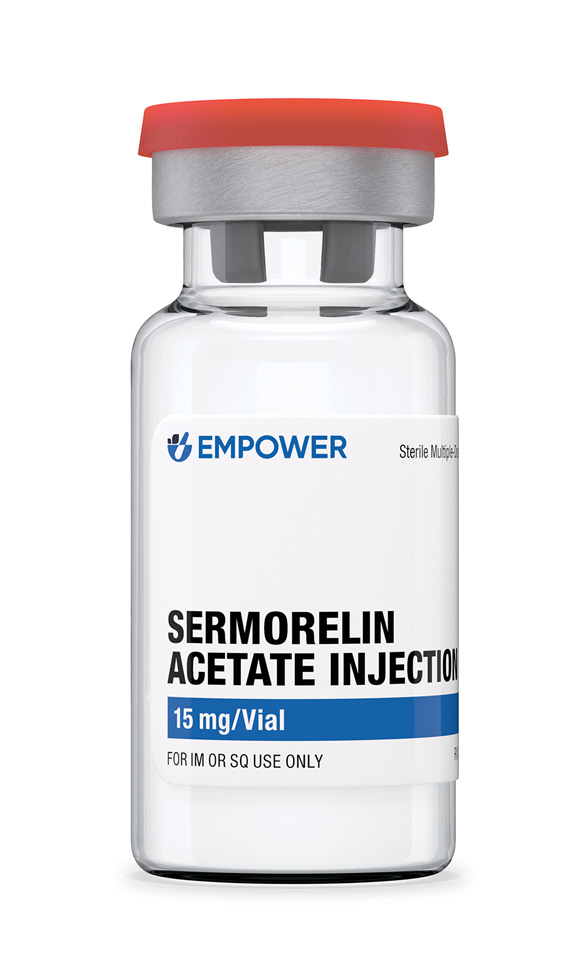


Sermorelin Acetate Injection
$127.00
Sermorelin acetate is a synthetic analog of growth hormone-releasing hormone (GHRH) consisting of the first 29 amino acids of natural human GHRH. It stimulates the pituitary gland to release endogenous growth hormone (GH).
By increasing GH secretion, sermorelin can raise insulin-like growth factor 1 (IGF-1) levels in the body.[2] This therapy is used primarily for diagnosed growth hormone deficiency, for example, in children who fail to grow due to inadequate GH production. In adults with confirmed GH deficiency, sermorelin may also be considered as a treatment option, although its use in healthy older adults for “anti-aging” purposes remains unproven and is not an FDA-approved indication.
General Dosing Information: The dosage of sermorelin must be individualized based on the patient’s age, weight (particularly in pediatric patients), and the condition being treated. Therapy should be supervised by a physician experienced in managing growth hormone disorders. The following are typical dosing guidelines:
- Therapeutic Dose (Adults): A common adult dosing regimen for growth hormone deficiency is 0.2 to 0.3 mg of sermorelin acetate injected subcutaneously once daily at bedtime. Dosing at night is thought to mimic the natural physiologic rhythm, as endogenous GH release is highest during sleep. The injection is given into the fatty subcutaneous tissue (often in the abdomen, thigh, or upper arm). The healthcare provider will determine the appropriate starting dose; some clinicians may start at the lower end (0.2 mg) and adjust based on IGF-1 levels and clinical response.
- Therapeutic Dose (Pediatrics): In children with idiopathic GH deficiency, sermorelin has historically been dosed according to body weight. A typical pediatric dose is approximately 0.03 mg per kilogram of body weight (30 µg/kg) once daily at bedtime. For example, a 20-kg child might receive around 0.6 mg nightly. This weight-based dosing is designed to stimulate adequate growth in growing children. Clinicians monitor growth velocity and IGF-1 levels and may adjust the dose over time. It’s important to note that in pediatric studies, sermorelin’s efficacy was variable; some children showed sustained increases in growth velocity over 12-36 months of therapy, while others responded less robustly (somatropin GH is generally more potent).[5] If a child does not respond to sermorelin, alternative treatments may be needed.
- Diagnostic Dose (Provocative Testing): In endocrinology practice, sermorelin (GHRH 1-29) can be used as a diagnostic agent to test pituitary GH reserve. For this purpose, an intravenous dose of 1.0 µg/kg is administered under medical supervision, and GH levels are measured in the blood at intervals thereafter. A normal pituitary will release a surge of GH in response. This diagnostic use is less common today, but may be seen in specialized testing. (This dosing is mentioned for completeness; diagnostic testing should only be done by healthcare professionals in a clinical setting.)
Administration Details: Sermorelin is supplied as a lyophilized powder in sterile vials that require reconstitution with the provided diluent (usually bacteriostatic water for injection). Patients or caregivers should be instructed thoroughly on how to prepare the injection.
The contents of the vial are mixed gently with the diluent (avoiding shaking, which can denature the peptide) until fully dissolved.[] The appropriate dose is then drawn up into an insulin-type syringe.
Injections are given subcutaneously (just under the skin), and injection sites should be rotated daily to prevent lipoatrophy or irritation. Common injection areas include the lower abdomen (at least 2 inches away from the navel), front of the thigh, or outer upper arm.
The evening timing (before bedtime) is recommended to leverage the body’s natural night-time GH peak and to reduce daytime inconvenience.
If a dose is missed, the patient should follow their physician’s guidance; generally, if it’s close to the next dose, skip the missed dose (do not double up doses).
All used needles and syringes must be disposed of in a proper sharps container.
Treatment Duration and Monitoring: The length of sermorelin therapy depends on the individual’s response and treatment goals. In children, therapy may continue for several years until an acceptable height is achieved or until growth plates close. In adults, treatment length varies based on symptom relief and IGF-1 targets, and some may use it indefinitely if benefits persist (with periodic re-evaluation).


Reviews
There are no reviews yet.