
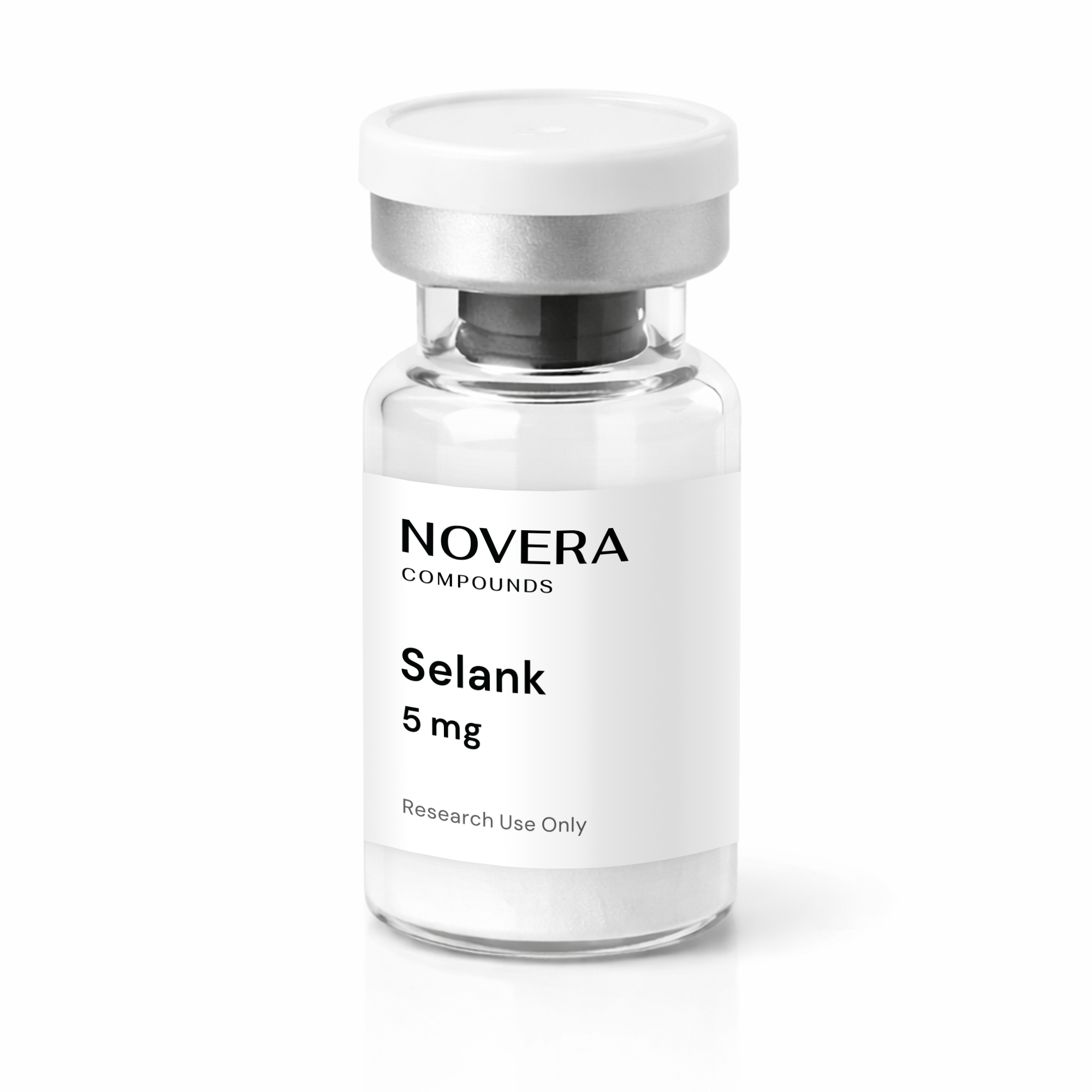


What is Selank (5 mg)?
Selank (5 mg) is a synthetic heptapeptide (7 amino acids) with the sequence Thr-Lys-Pro-Arg-Pro-Gly-Pro (TKPRPGP). It was developed as an analogue of tuftsin, an endogenous peptide involved in immune signaling.
In research, Selank is often grouped with brain, cognitive, and nootropic peptides. It is used to explore how short peptides can influence central nervous system (CNS) signaling, gene expression, and immune-related pathways in preclinical models.
The 5 mg format is typically chosen for smaller-scale studies, method development, and experiments that require more control over working stocks, while still using the same sequence-defined material from broader Selank research.
Product Specifications
- Peptide Sequence: Thr-Lys-Pro-Arg-Pro-Gly-Pro
- Chemical Formula: C₃₃H₅₇N₁₁O₉
- Molecular Weight: 751.9 g/mol
- CAS Number: 129954-34-3
- Purity: Research-grade synthetic peptide, typically ≥98–99% by HPLC. Identity and molecular mass are commonly verified by HPLC and mass spectrometry, with lot-specific results provided in the certificate of analysis (COA).
- Packaging Format: 5 mg lyophilized (freeze-dried) Selank in a sealed vial, intended for preparing small-volume stocks for cell-based assays, slice preparations, and pilot preclinical study workflows.
- Storage Conditions: Store at −20 °C, protected from light and moisture. Limit temperature cycling to help maintain stability.
- Intended Use: For laboratory research use only; not for human or veterinary use.
Key Characteristics of Selank (5 mg)
- Tuftsin-Derived Peptide Analogue: Selank, also known as Selanc, is structurally based on tuftsin and contains a glyproline (PGP) motif that enhances stability and potential CNS relevance in research.
- Neurochemical Signaling and Gene-Expression Effects: Studies report that Selank can affect the expression of genes involved in GABAergic neurotransmission, such as GABA_A receptor subunits and related proteins. Research also suggests that it affects serotonin systems and brain-derived neurotrophic factor (BDNF).
- Neuroimmune and Cytokine Modulation: Investigations indicate that Selank can influence immune-related transcription patterns, including effects on IL-6 and other cytokines, and may alter Th1/Th2 balance in immune cells.
- Enkephalinase and Peptidase Activity: In enzyme assays, Selank has been studied for its ability to inhibit enkephalin-degrading enzymes, which is useful for experiments on peptide turnover and related signaling mechanisms.
- Practical Small-Quantity Format for Research: The 5 mg presentation is ideal for experiments requiring precise titration and reduced material waste (e.g., pilot assays or protocol optimization), while maintaining the same high-quality analytical documentation (COA/HPLC/MS) as larger formats.
How Selank (5 mg) Supports Research
Selank (5 mg) serves as a small, sequence-defined probe to study the effects of peptides on neurotransmission and immune signaling. Its reported impact on GABA-related gene expression, monoamine pathways, BDNF-related markers, and cytokine profiles allows researchers to investigate how a single peptide may influence multiple signaling layers in brain and immune tissues in preclinical models.










Reviews
There are no reviews yet.