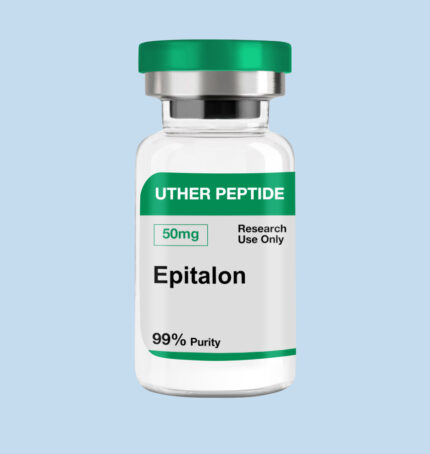
Epithalon

$39.00

Category:
Description

Epithalon (Epitalon) is a synthetic tetrapeptide studied for its potential role in telomerase activation and cellular aging regulation. Derived from epithalamin research, it has been investigated in models of telomere biology and pineal gland signaling. In experimental contexts, Epithalon is explored for its influence on cellular longevity pathways, melatonin regulation, and genomic stability mechanisms. Intended strictly for laboratory and research use.

Clinical Status

Human RCT ▣ | Observational ▣ | Animal ✔ | In vitro ✔

Primarily studied in preclinical and regional aging research contexts, with limited exploratory human data.

Mechanism of Action​

Epithalon is studied for its potential to activate telomerase, an enzyme that helps maintain telomere length in dividing cells. By influencing telomere biology, it is explored in research focused on cellular aging and genomic stability.

Benefits

  • Investigated for telomerase activation and telomere maintenance:
    Telomeres shorten progressively with each cell division, eventually contributing to replicative senescence. Epithalon has been studied for its potential to increase telomerase activity, the enzyme responsible for extending telomeric DNA sequences. In laboratory models, activation of telomerase is associated with delayed cellular aging markers. By influencing this enzymatic pathway, Epithalon is positioned within telomere biology research.
  • Supports genomic stability research:
    Telomere shortening can lead to chromosomal instability and altered gene expression. Maintaining telomere length is associated with preservation of genomic integrity in experimental systems. Epithalon is explored for its influence on chromosomal end protection mechanisms, contributing to investigation of cellular stability pathways.
  • Engages cellular senescence pathways:
    Cellular senescence is characterized by growth arrest and altered gene expression. Telomerase modulation may influence the timing of senescence onset in dividing cells. Epithalon is studied within models examining how telomere dynamics interact with aging-associated signaling networks.
  • Influences pineal gland and circadian regulation research:
    Epithalon originates from research on epithalamin, associated with pineal gland activity. The pineal gland regulates melatonin secretion and circadian rhythms. Modulation of pineal-related signaling pathways connects Epithalon to neuroendocrine aging research domains.
  • Examined in oxidative stress response models:
    Oxidative stress contributes to telomere shortening and cellular damage. Experimental systems investigating Epithalon often evaluate oxidative stress markers alongside telomere dynamics. This positions the peptide within broader cellular resilience research frameworks.
  • Studied in replicative lifespan models:
    By influencing telomerase activity, Epithalon has been examined in cellular models assessing replicative potential. Increased replicative capacity is linked to extended cellular lifespan in controlled laboratory conditions. These findings support its inclusion in experimental longevity research discussions.
  • Targets aging biology at the chromosomal level:
    Unlike hormonal peptides that act on membrane receptors, Epithalon operates at the genomic regulation level. Its focus on telomere biology differentiates it from endocrine modulators. This molecular positioning places it within high-level aging research rather than metabolic or anabolic categories.
  • Supports integrated longevity pathway investigation:
    Aging is influenced by interconnected processes including telomere shortening, oxidative stress, and circadian disruption. Epithalon is studied as a multi-pathway modulator within this framework. Its role in telomere and pineal research integrates genomic and neuroendocrine perspectives in experimental aging models.

Research Data​

Study / Model Reported effect
Human somatic cell culture ↑ Telomerase activity, ↑ telomere length in dividing cells
Aged mice longevity studies Extended median lifespan, ↓ age-related tumor incidence
Pineal gland animal models Restored melatonin secretion rhythm, normalized circadian markers
Elderly human observational cohort Improved sleep architecture, ↑ nocturnal melatonin levels
Retinal degeneration rat model ↓ Photoreceptor loss, preserved retinal pigment epithelium
Oxidative stress in vitro assays ↓ Lipid peroxidation, ↑ antioxidant enzyme expression
Immunosenescence rodent studies Restored T-cell function, normalized thymic activity

Stack Suggestions​

Epithalon is often combined in research with:

  • Epithalon + BPC-157 → Pairs telomere-related research with tissue regeneration and cytoprotective pathways.
  • Epithalon + GHK-Cu → Combines telomerase-focused research with extracellular matrix and skin aging models.
  • Epithalon + NAD+ → Explores intersecting pathways of cellular aging, mitochondrial function, and genomic stability.
  • Epithalon + Thymalin → Investigates combined pineal–thymic signaling in immunosenescence research.

⚠ Stacks are for experimental design only; not safety or efficacy guidance.

Pen Dosage Chart​

Epithalon Pen 20 mg
Volume 2 mL
mg/mL 10 mg/mL
Click-to-Dose 1 click = 0.1 mg
Example(s) 10 clicks = 1 mg

Dosage & Protocols Variations​

Standard Research Protocol

  • Dose: 5 – 10 mg
  • Duration: 2 – 3 weeks
  • Frequency: Daily
  • Cycle Interval: 4 – 6 months off before repeating
  • Goal / Description: Baseline protocol used in telomerase activation and cellular aging models.

Therapeutic Research Protocol

  • Dose: 10 – 20 mg
  • Duration: 10 – 20 days
  • Frequency: Daily or split into two administrations
  • Cycle Interval: 3 – 6 months off before repeating
  • Goal / Description: Higher-dose schedule explored in longevity and pineal signaling research.

Biohacker Protocol (experimental)

  • Dose: 2 – 5 mg
  • Duration: 4 – 6 weeks
  • Frequency: 5 days per week
  • Cycle Interval: 2 – 3 months off before repeating
  • Goal / Description: Microdose continuous approach in experimental aging models.

Possible Side Effects​

Epithalon is generally well-tolerated in preclinical and limited human observational studies.

Reported side effects are rare and typically mild:

  • Transient drowsiness or mild fatigue following administration.
  • Localized irritation, redness, or tenderness at injection site.
  • Occasional mild headache during initial dosing periods.
  • Temporary changes in sleep patterns linked to pineal signaling modulation.

No evidence of hormonal, hepatic, or systemic adverse effects has been observed in available research data.

Product Attributes​

  • CAS #: 307297-39-8
  • Molecular Formula: C14H22N4O9
  • Sequence (AA): AEDG
  • Molecular Weight: 390.35 g/mol
  • PubChem CID: 219042
  • Half-Life: ~30 minutes
  • Synonyms: Epitalon, Epithalone, Ala-Glu-Asp-Gly, AEDG peptide
  • Type: Synthetic research tetrapeptide (pineal-derived analog)
  • Research Focus: Longevity & Cellular Aging, Telomere Biology

Reviews (0)

Reviews

There are no reviews yet.

Be the first to review “Epithalon”

Your email address will not be published. Required fields are marked *

Shipping and Delivery

MAECENAS IACULIS

Vestibulum curae torquent diam diam commodo parturient penatibus nunc dui adipiscing convallis bulum parturient suspendisse parturient a.Parturient in parturient scelerisque nibh lectus quam a natoque adipiscing a vestibulum hendrerit et pharetra fames nunc natoque dui.

ADIPISCING CONVALLIS BULUM

  • Vestibulum penatibus nunc dui adipiscing convallis bulum parturient suspendisse.
  • Abitur parturient praesent lectus quam a natoque adipiscing a vestibulum hendre.
  • Diam parturient dictumst parturient scelerisque nibh lectus.

Scelerisque adipiscing bibendum sem vestibulum et in a a a purus lectus faucibus lobortis tincidunt purus lectus nisl class eros.Condimentum a et ullamcorper dictumst mus et tristique elementum nam inceptos hac parturient scelerisque vestibulum amet elit ut volutpat.